Free UK mainland delivery over £500 ex VAT

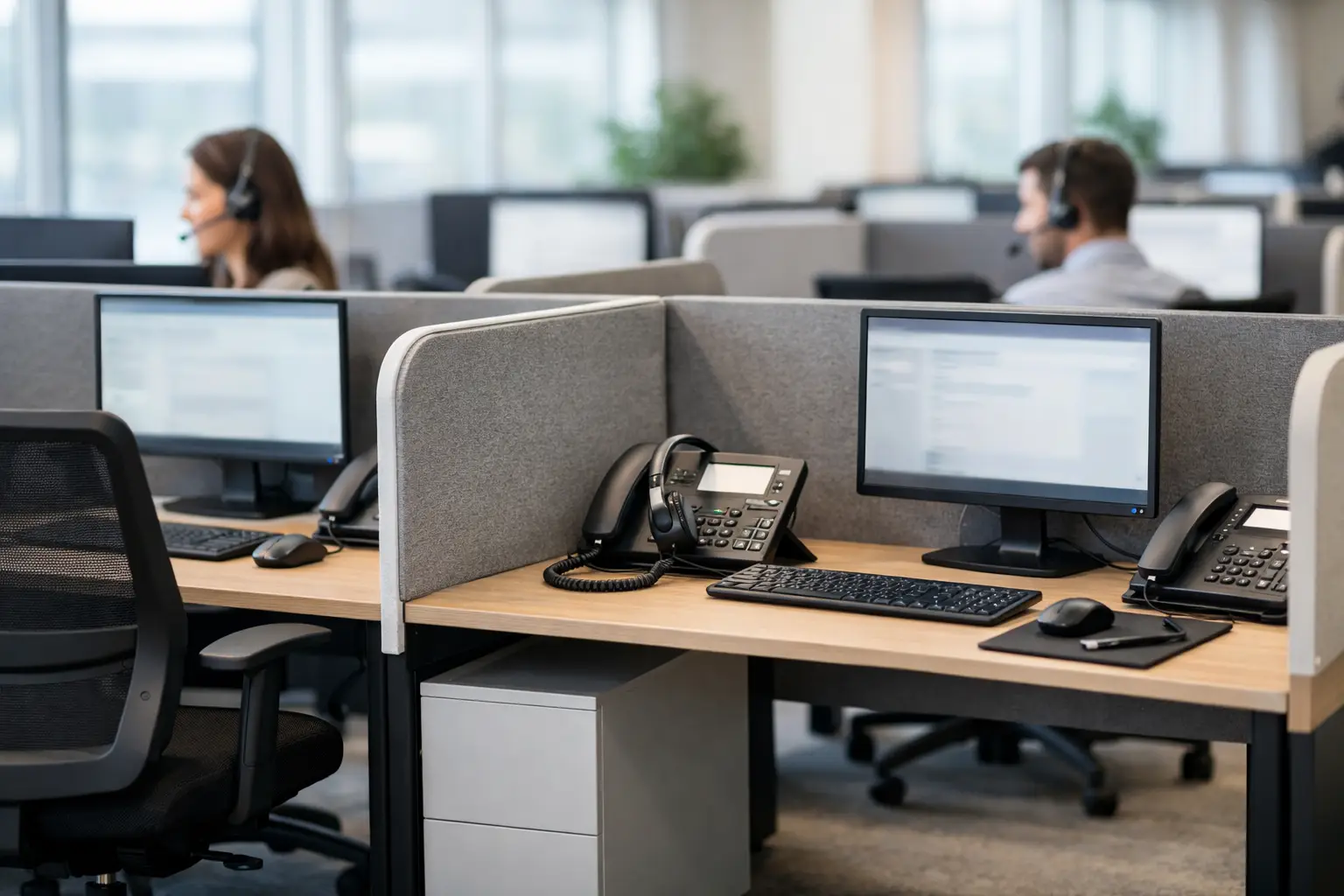
A call centre desk has a tougher job than a standard office workstation. It needs to hold screens, phones, headsets and personal items without making the operator feel boxed in. It must support long periods of concentrated work, manage cables safely and help supervisors use every square metre sensibly. So, which desks suit call centres? In most cases, practical bench desking or individual rectangular desks will provide the best balance of capacity, comfort and cost.
The right answer still depends on the way your team works. A busy customer service floor with fixed positions has different needs from a smaller support team where staff alternate between calls, administration and meetings. Before choosing a range, it pays to consider occupancy, technology, noise, privacy and how the room may need to change as the business grows.
For many call centres, bench desks are the first option to consider. They place two or more workstations along a shared framework, with either a central cable tray or built-in cable management. This creates a clean, consistent layout and makes efficient use of floor space without compromising the working area available to each person.
A typical two-person bench arrangement works particularly well where operators sit in rows. Screens can be positioned on monitor arms, power can run through the desk or a central tray, and desk screens can be added between colleagues where needed. The result is a more orderly room that is easier to clean, maintain and reconfigure than a collection of unrelated desks.
Individual rectangular desks are also a strong choice, especially for smaller teams, mixed-use rooms or organisations that expect layouts to change regularly. They are straightforward, familiar and available in a wide range of widths and depths. A rectangular desk can be used on its own, placed back-to-back, or arranged in pods, so it gives facilities teams useful flexibility.
Corner desks are less common on the main call floor, but they can suit team leaders, quality managers and staff whose role includes call handling alongside paperwork. The return provides a separate surface for files, training materials or a second monitor. They are usually better reserved for perimeter positions because a large number of corner desks can make the central space feel crowded.
The equipment assigned to each operator should determine the minimum desk size. A member of staff using one compact monitor and a softphone may work comfortably on a smaller workstation. Someone using dual screens, a desk phone, reference documents and a keyboard needs more depth and width to maintain a sensible viewing distance and avoid clutter.
As a practical starting point, a 1,200mm wide desk can suit a compact single-screen position, while 1,400mm to 1,600mm wide workstations are often more comfortable for dual-screen call handling. Desk depth matters just as much. A 700mm or 800mm deep top generally gives better room for monitors, keyboard placement and a clear working area than a shallow desk.
Avoid specifying the smallest possible desk simply to fit more people into the room. A tight layout can lead to cluttered surfaces, restricted access and greater noise distraction. It also makes future changes difficult if the team adopts larger screens or additional equipment.
Monitor arms are worth considering alongside the desks themselves. They free up valuable surface space, allow staff to adjust screen height and make it easier to keep rows of desks consistent. Check that the desktop and screen arrangement can accommodate clamp-mounted arms, particularly where desks have modesty panels, cable trays or back-to-back configurations.
Call centre work is often screen-intensive and repetitive, so comfort should be built into the workstation rather than treated as an optional extra. The desk needs to work with an adjustable task chair, allowing the operator to sit with feet supported, shoulders relaxed and screens at an appropriate height.
Fixed-height desks remain the most cost-effective choice for many high-occupancy call centres. A well-specified fixed desk paired with an adjustable chair, monitor arms and sensible screen positioning can support a comfortable working environment for a large team.
Sit-stand desks may be appropriate for smaller specialist teams, hybrid customer service areas or roles where staff spend part of the day on calls and part on administration. They offer individual movement and choice, but they cost more, require power planning for electric models and can reduce the simplicity of a densely planned desk run. They are not automatically necessary at every position.
If hot desking is part of the operating model, adjustability becomes more valuable. Shared workstations need to accommodate people of different heights and working preferences, so sit-stand frames, adjustable monitor arms and properly adjustable seating can make a noticeable difference.
Operators need to focus on the caller, but total visual separation is rarely the answer. High screens can make supervision more difficult, reduce natural light across the room and leave staff feeling isolated. Very low or no screens can create visual distraction and expose every desk to surrounding movement.
Medium-height desk screens are often the practical middle ground. Fabric or acoustic desk screens can give each operator a defined working zone, soften sound travelling directly across a desk run and provide a useful pinboard surface. They should not be treated as a full acoustic solution, however. In a busy room, ceiling treatments, wall panels, acoustic pods and sensible zoning may also be needed to control background noise.
Consider sightlines as part of the furniture plan. Team leaders should be able to support operators without walking around obstacles, while staff should have a clear route to exits, printers and breakout spaces. A well-planned room feels calmer because people can move through it without interrupting calls.
A desk covered in loose leads is difficult to use and harder to maintain. Call centre positions can involve monitor cables, power leads, network connections, charging points and phone equipment, all of which need a planned route from floor to desktop.
Bench desks with central cable trays are particularly useful for this reason. They keep shared services within the desk structure and reduce visible trailing cables. On individual desks, cable trays, vertical cable risers and under-desk power modules should be specified from the beginning rather than added after installation.
Think carefully about where power and data enter the room. Floor boxes may suit a central bench arrangement, while perimeter desks can often use wall services. A good space plan will coordinate desk positions with access to services before furniture is ordered, helping to avoid expensive alterations later.
Desk size is only one part of call centre capacity. The space around the desk affects safety, comfort and everyday operation. Staff need enough room to pull out chairs, pass behind colleagues and reach storage without disruption.
As a general planning principle, allow clear circulation routes between desk runs and avoid placing chairs directly into main walkways. The exact dimensions will depend on the room, fire routes, accessibility requirements and the furniture selected, so each plan should be assessed individually. Trying to gain one or two extra positions can create an awkward layout that costs more in staff frustration than it saves in floor space.
Storage also deserves a place in the plan. Many call centres are moving towards paper-light working, but operators still need somewhere for personal belongings, headsets, stationery and occasional documents. Personal lockers, low storage units and shared cupboards can keep desks clear, while placing printers and recycling points away from active call positions helps reduce interruptions.
Commercial desks need durable tops and frames that stand up to daily use, cleaning and occasional moves. Neutral finishes are often the easiest choice for a large call floor because they keep the room light and make replacement furniture easier to match later. Wood-effect finishes can make a customer service environment feel less institutional, while darker tops may be useful where visible wear is a concern.
For consistency, choose a desk range that also offers matching meeting tables, team leader desks, storage and screens. This creates a more considered workplace without requiring a different supplier for every area. It also makes it easier to expand in stages when headcount changes.
The best desk is only effective when it is part of a workable room plan. Measuring the space, confirming service locations and testing desk configurations before placing an order can prevent wasted budget and difficult installation days. For organisations in East Anglia, Orbis Furniture can help with a site survey and practical space planning, while remote support is available for wider GB projects.
A call centre should give people enough room to listen, speak and concentrate without feeling squeezed into a production line. Start with the equipment and staff needs, then select desks that support a tidy, adaptable layout. If you are weighing up bench desks, individual workstations or a mixed arrangement, get in touch for straightforward advice and pricing that fits the space you have.
Projects and fit-outs
Chairs, desks, tables, storage and soft seating, with free standard delivery to UK mainland addresses on orders over £500 excluding VAT.
Office and educational furniture specialists based in Lowestoft, supplying Suffolk, Norfolk and the whole of the UK. Chairs, desks, tables, storage and soft seating from one supplier, at low prices.
Get in touch
Riverside Business Centre, Riverside Road, Lowestoft, Suffolk, NR33 0TQ
Delivery
Free standard delivery to UK mainland addresses on select orders or orders over £500 excluding VAT. Next working day, pre-build and installation options available on most ranges at checkout.
© 2026 Orbis Furniture Ltd. Registered in England and Wales, company number 12397240. VAT number GB 362 8523 86.