Free UK mainland delivery over £500 ex VAT

Office Lockers Versus Cupboards: Which Fits?
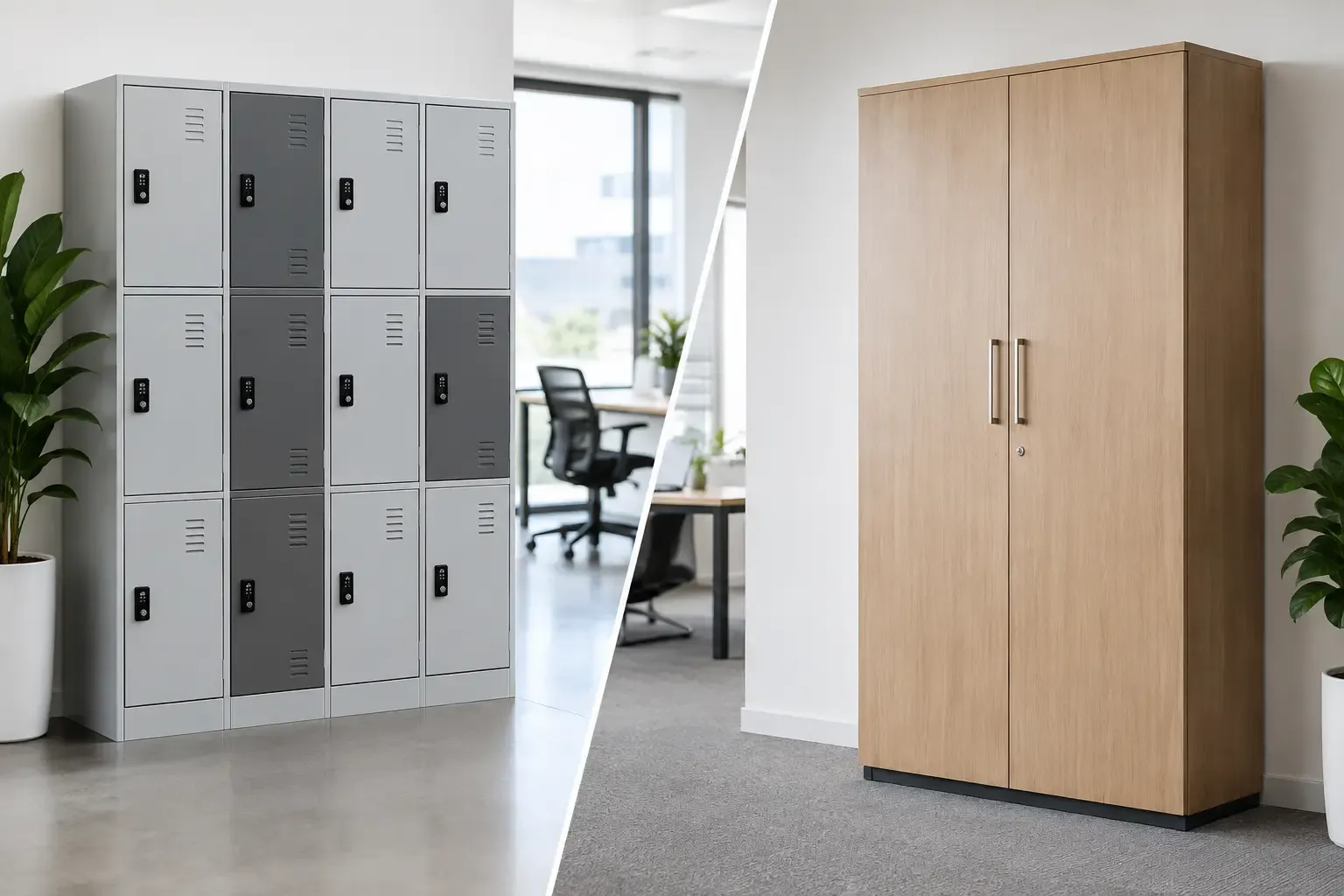
A cleaner may need somewhere secure to leave personal belongings between shifts. A facilities team may need to store spare stationery, IT equipment or cleaning supplies. Those are different jobs, which is why the choice between office lockers versus cupboards should start with what needs storing, who needs access and how often the contents are used.
Both products can make an office, school or public-sector workplace feel more organised. However, they deliver value in different ways. Lockers provide individual, controlled storage; cupboards offer flexible shared capacity. Choosing the wrong one can leave staff short of personal space, or fill a valuable room with storage that is awkward to use.
Office lockers versus cupboards: the key difference
The simplest distinction is ownership. A locker is normally assigned to one person, or used by one person at a time. It is designed for personal possessions, with separate lockable compartments that keep items private and identifiable.
A cupboard is usually shared storage. It may be locked, but everyone with authorised access can use the same internal space. Cupboards are better suited to folders, stock, consumables, equipment and other workplace resources that need to be stored together.
This difference matters when planning a workplace. If staff regularly bring bags, coats, helmets, medication or valuable items into the building, individual lockers are often the sensible option. If the aim is to keep an admin area, classroom or store room tidy, cupboards generally provide more usable volume for the floor space they occupy.
When office lockers are the better choice
Lockers work best where privacy, accountability and personal storage are priorities. They are a practical addition to offices operating hot-desking or hybrid working, where people do not have a permanent pedestal or desk drawer. A bank of lockers gives employees a reliable place to keep their belongings while they use any available workstation.
They are equally useful in schools, staff rooms, leisure facilities, warehouses and public buildings. In these settings, personal property may need to be stored for a full shift or working day, sometimes away from the person using it. A lockable compartment makes that arrangement more reassuring for both staff and management.
Security and personal responsibility
The strongest argument for lockers is controlled access. Each compartment can have its own key lock, combination lock, hasp and staple for a padlock, or an electronic locking option depending on the product and level of control required. This helps reduce disputes over missing belongings and creates a clearer line of responsibility.
That said, not every organisation needs the same locking arrangement. Key locks can be straightforward and cost-effective, but keys can be misplaced and replacements need managing. Combination and digital locks can avoid key administration, although they may need resets, batteries or a more considered user policy. For a school or busy workplace, it is worth thinking through who will administer access before selecting the lock type.
A good fit for changing work patterns
Hot-desking has made lockers more relevant in many offices. Without a fixed desk, staff still need somewhere to put a coat, laptop bag, lunch or confidential papers while attending meetings or moving around the building.
For this purpose, consider whether lockers will be allocated permanently or used on a day-use basis. Permanent allocation is easy for regular staff but can leave capacity unused when people work remotely. Day-use lockers may make better use of space, particularly where occupancy changes through the week. The right approach depends on headcount, attendance patterns and whether the workplace welcomes visitors, contractors or agency staff.
Points to check before ordering lockers
Locker dimensions need careful attention. A compact compartment may be sufficient for a handbag and personal items, while a full-height locker is more appropriate for coats, uniforms or cycle helmets. Consider the internal height and width, not only the overall footprint.
Door layout affects capacity too. A single-door locker offers more room per user, whereas two-, four- or six-door models increase the number of users served within the same cabinet height. More doors do not always mean better value if the compartments are too small for the items people actually carry.
Also allow room for doors to open and for people to stand at the lockers without blocking a corridor or escape route. In a narrow staff area, this can influence whether a different locker depth or cupboard layout is the more practical choice.
When cupboards offer better value
Cupboards are often the most efficient answer when storage is shared and the contents vary in size. They can accommodate archive boxes, lever arch files, printer paper, spare cables, display materials, teaching resources, first-aid supplies and general office stock far more easily than a run of individual lockers.
A well-chosen cupboard keeps clutter out of sight while allowing a team to access everyday essentials quickly. In an open-plan office, this can improve the appearance of the space and reduce the tendency for supplies to gather on desks, windowsills and meeting tables.
Flexible storage for teams and departments
Internal shelves make cupboards adaptable. Adjustable shelving can accommodate tall folders one month and boxes of supplies the next. This is especially helpful for growing businesses and schools where requirements can change during the year.
For shared stationery or equipment, a lockable cupboard gives managers appropriate control without creating a separate key or code for every user. It is also easier to organise with labelled shelves, storage trays or archive boxes. The result is a central home for supplies rather than several partly filled lockers that are difficult to monitor.
Cupboards are particularly useful in back-of-house areas, print zones, finance departments, classrooms and meeting-room stores. They can sit alongside desks or be positioned against a wall to create a tidy storage run. Height matters here: low cupboards can double as a useful surface for printers or displays, while taller units maximise vertical space where floor area is limited.
Security is available, but it is shared
A lockable cupboard is not inherently less secure than a locker. The difference is that it protects a shared collection of items rather than separating one person’s belongings from another’s. For confidential files, valuable equipment or controlled stock, this may be exactly what is needed.
The decision comes down to access. If several people need the same resources, a cupboard is easier to manage. If each person needs privacy, a shared cupboard can quickly become inconvenient and less secure in practice. Avoid treating a lockable cupboard as a substitute for personal lockers unless staff are genuinely comfortable sharing the space.
Choose by what you need to store
The quickest way to make the right choice is to assess the storage task rather than buying by appearance alone. Personal bags, coats, uniforms and possessions point towards lockers. Paperwork, stationery, cleaning materials, educational resources and team equipment generally point towards cupboards.
Some workplaces need both. For example, a hybrid office may use lockers for personal property and cupboards for shared stationery, files and IT accessories. A school may provide staff lockers in a secure room while using cupboards in classrooms for books and teaching materials. Combining the two creates a clearer division between personal and operational storage.
It is also worth considering whether storage needs to be mobile, freestanding or integrated with the wider furniture scheme. Matching finishes can help cupboards sit comfortably with desks and tables, while locker colour options can be used to support wayfinding or give staff areas a more welcoming feel. Practical storage does not have to look like an afterthought.
Plan for the room, not just the product
Storage performs best when it is planned into the room from the outset. Measure wall space, ceiling height, door swings, radiators, sockets and circulation routes. Think about how people will use the area at busy times, such as the start of the day, shift changes or before a meeting.
A tall cupboard may offer excellent capacity but be unsuitable beneath a window or in a room with limited wall height. A bank of lockers may technically fit along a wall but cause congestion if everyone needs them at the same time. In smaller offices and schools, a simple layout conversation can prevent costly compromises later.
Weight is another consideration. Heavy folders, paper and equipment require suitable shelving and sensible loading. For cupboards storing confidential records, confirm the required level of security and whether a particular filing or records-management process needs to be followed. For lockers, establish how lost keys, abandoned belongings and end-of-employment access will be handled.
Getting the balance right for your workplace
There is no single winner in office lockers versus cupboards. Lockers are the stronger choice for private, individual storage and workplaces with flexible desks or changing shifts. Cupboards are more adaptable for shared supplies, documents and equipment, often delivering greater general capacity from a compact footprint.
Before committing, list the items that need a home, estimate how many people require access and look at the available room as it will be used on a busy day. If you are planning a larger office, school or public-sector fit-out, Orbis Furniture can help you compare storage options alongside desks, seating and layout requirements. Get in touch to discuss a practical storage plan and pricing that suits your space.