Free UK mainland delivery over £500 ex VAT

A chair that feels perfectly acceptable for a 20-minute meeting can become a daily complaint after six hours at a screen. That is why the choice between mesh chairs versus task chairs deserves more thought than simply matching a finish to the office décor. For employers, schools and public sector teams, the right seating needs to suit the people using it, the work being done and the budget available.
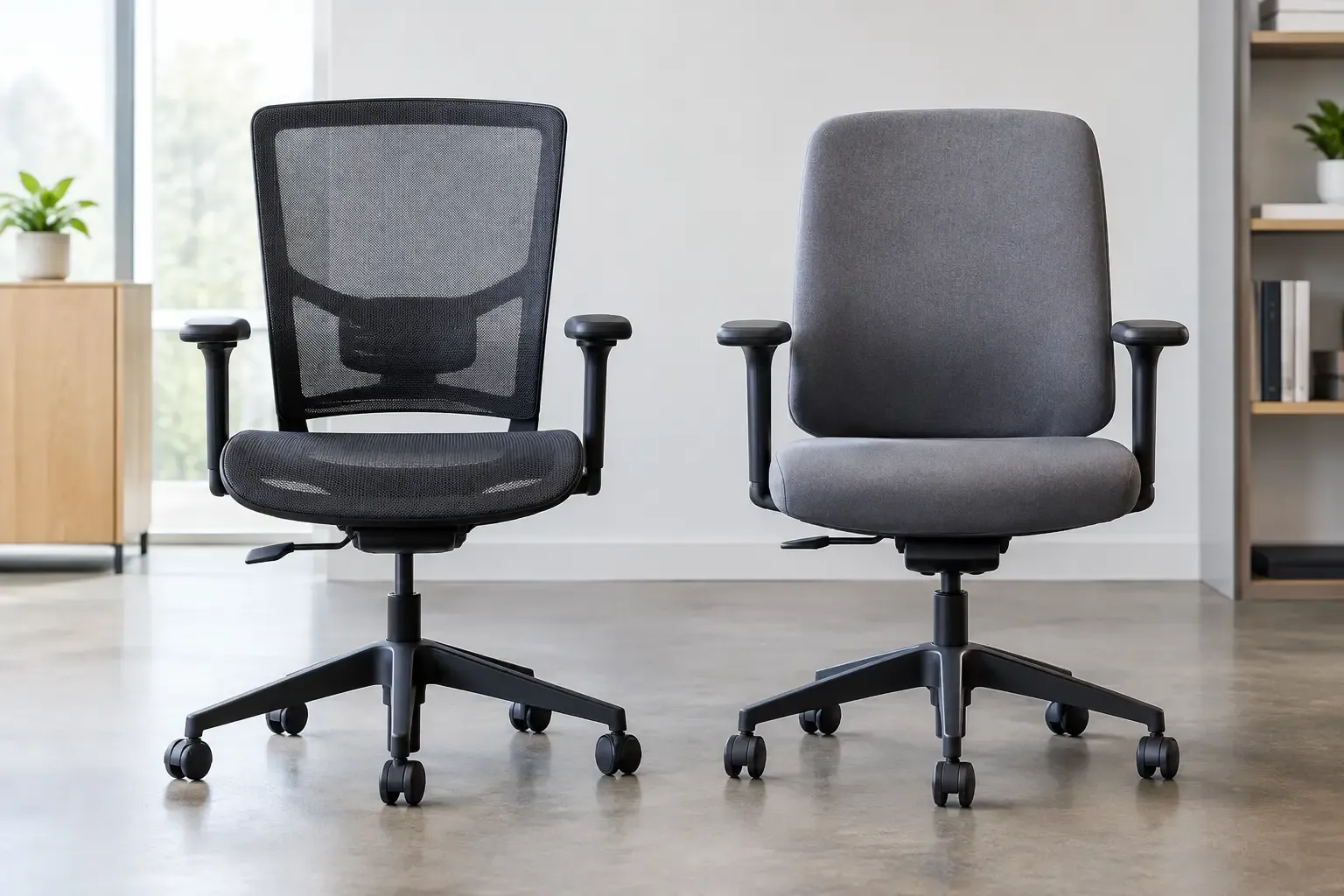
There is one point worth clearing up first: a mesh chair can also be a task chair. “Mesh” usually describes the backrest material, while “task chair” describes a chair intended for regular desk-based work. The practical decision is often between a mesh-backed task chair and an upholstered task chair with a foam-padded back and seat.
Mesh-backed chairs use a tensioned fabric across the backrest, usually paired with a padded fabric seat. They are popular in busy offices because the open weave allows air to circulate and gives the chair a lighter visual appearance. This can be especially useful in warm rooms, densely occupied offices and spaces where large upholstered chairs would make the layout feel crowded.
Traditional upholstered task chairs have a padded seat and padded backrest, normally finished in fabric. They are available in a very wide range of sizes, mechanisms and price points. A well-specified task chair can offer excellent support for individual users, particularly where people spend most of the day seated and need several adjustments.
Neither option is automatically better. The best choice depends on the length of use, the variety of users, the room temperature, the desired appearance and whether the chairs need to support a formal display-screen equipment assessment.
A mesh chair is often a practical choice for shared offices, hot-desking areas and management workstations. Its breathable back can feel cooler than a thick upholstered backrest, which is a genuine advantage during busy working days or in offices with limited temperature control.
Mesh also works well visually. The backrest is less bulky, so it can help maintain clear sightlines across open-plan spaces. For smaller offices, training rooms and meeting areas that double as touchdown workspaces, this lighter profile can make a noticeable difference.
Many mesh models include a shaped lumbar area, height-adjustable arms, seat-slide adjustment and synchro tilt mechanisms. These features allow the chair to be set up for different body shapes and working styles. In a workplace where staff share desks, easy-to-use adjustments matter as much as the material on the backrest.
There are trade-offs. Mesh tension varies considerably between chair ranges. Lower-cost mesh can feel hard, overly flexible or less supportive over time, while better-quality mesh holds its shape and provides more controlled support. It is therefore worth checking a sample or arranging a trial where possible, rather than buying purely from an image and specification sheet.
An upholstered task chair is often the more flexible answer where staff are seated for long periods or where a more tailored seating specification is required. Foam-padded backs can provide a softer, more enveloping feel, and many chairs offer optional lumbar pumps, headrests, adjustable back height and specialist mechanisms.
This makes upholstered task seating a strong choice for dedicated desks, call-handling teams, administrative departments and roles involving prolonged computer work. A chair with the right seat depth, back support and arm adjustment can help the user maintain a more comfortable, supported position throughout the day.
Fabric task chairs also offer more choice in colour and finish. That can be useful when furniture needs to fit an established scheme, reflect school colours or bring warmth to a client-facing office. With commercial-grade upholstery, they remain a sensible option for high-use environments.
The main consideration is heat. Padded upholstery can feel warmer, particularly in a sunny office or for users who naturally run hot. It may also need more attention to cleaning if the workspace is prone to spills, dust or frequent visitor use. Selecting an appropriate hard-wearing fabric and arranging a sensible cleaning routine will help protect the investment.
When comparing mesh chairs versus task chairs, it is easy to focus on appearance and overlook the controls that affect day-to-day comfort. For regular screen-based work, a chair should allow the user to set the seat height so their feet are supported on the floor or a footrest, with their knees and hips in a comfortable position.
Seat depth is particularly valuable for a mixed workforce. A sliding seat lets shorter and taller users achieve better support behind the thighs without the front edge pressing into the backs of the knees. Adjustable lumbar support can also be useful, but it must be positioned correctly to make a difference.
Armrests need careful thought. Adjustable arms can support the forearms while typing or using a mouse, yet poorly set arms can stop the chair fitting under a desk or encourage the shoulders to rise. In compact workstations, height-adjustable or multi-adjustable arms are often worthwhile, while armless chairs may suit certain bench desk layouts.
A synchro mechanism is another feature to consider. It lets the seat and back move together as the user reclines, supporting movement rather than locking someone into one upright position. For chairs used all day, this is usually preferable to a basic fixed-back mechanism.
It is sensible to match the chair specification to the expected use. A chair for occasional laptop work in a meeting room does not need the same level of adjustment as one used by an employee for seven hours a day. Buying a highly specified chair everywhere may not be necessary, but under-specifying daily-use seating can quickly become a false economy.
For a growing business, it can be helpful to create two or three seating standards. For example, a fully adjustable task chair for permanent desk users, a capable mesh chair for shared workstations, and simpler visitor or meeting seating for short-duration use. This keeps the purchase practical while giving staff appropriate support where it is most needed.
Do not judge value by the initial chair price alone. Consider warranty, expected lifespan, replacement parts, fabric suitability, delivery access and assembly. A chair that is easier to adjust, more durable and better suited to the user may reduce complaints and replacements over its working life.
Even an excellent chair cannot compensate for a poorly arranged desk. Monitor height, keyboard position, desk depth and personal storage all influence posture and comfort. A user leaning forward to see a low screen or twisting to reach equipment will still be uncomfortable, regardless of whether their chair has mesh or upholstery.
Before ordering in volume, assess a typical workstation and identify the people who will use it. Consider whether desks are fixed or shared, whether there is enough room for chairs to move freely, and whether arms will fit beneath the worktop. In schools and public buildings, also consider how easily chairs can be cleaned and whether they need to withstand frequent changes of user.
For larger projects, a site survey and space plan can prevent costly assumptions. It is much easier to spot restricted access, tight desk clearances or an unsuitable chair footprint before delivery than after a room is fitted out.
If your priority is airflow, a clean contemporary look and straightforward shared use, a quality mesh-backed task chair is likely to be a good fit. If users need a more cushioned feel, extensive individual adjustment or a specific fabric finish, an upholstered task chair may be the stronger option.
The sensible next step is to compare chairs against your actual working environment rather than a generic checklist. Orbis Furniture can help you narrow the options by use, budget and workspace layout, then provide practical recommendations and pricing for your requirement. Get in touch before placing a large order - a short conversation now can lead to a much more comfortable workplace for years to come.
Projects and fit-outs
Chairs, desks, tables, storage and soft seating, with free standard delivery to UK mainland addresses on orders over £500 excluding VAT.
Office and educational furniture specialists based in Lowestoft, supplying Suffolk, Norfolk and the whole of the UK. Chairs, desks, tables, storage and soft seating from one supplier, at low prices.
Get in touch
Riverside Business Centre, Riverside Road, Lowestoft, Suffolk, NR33 0TQ
Delivery
Free standard delivery to UK mainland addresses on select orders or orders over £500 excluding VAT. Next working day, pre-build and installation options available on most ranges at checkout.
© 2026 Orbis Furniture Ltd. Registered in England and Wales, company number 12397240. VAT number GB 362 8523 86.