Free UK mainland delivery over £500 ex VAT

A bank of desks beside a busy meeting space can quickly become the noisiest part of an office. Staff may hear every phone call, video meeting and conversation, even when the room looks well furnished. So, do acoustic screens block noise? They can make a real difference, but they are not a solid wall and should not be specified as one.
Acoustic screens are designed primarily to absorb sound and interrupt its path through a space. Used in the right layout, with suitable materials and sensible workstation planning, they can reduce distractions and improve speech privacy. The result is usually a calmer, more workable office, classroom or shared public sector environment - not complete silence.
Most office acoustic screens use an absorbent core wrapped in fabric, felt or another acoustic finish. When sound waves hit the screen, part of that sound energy is absorbed rather than bouncing back into the room. This helps control reverberation, which is the build-up of reflected sound that makes an open-plan area feel busy and tiring.
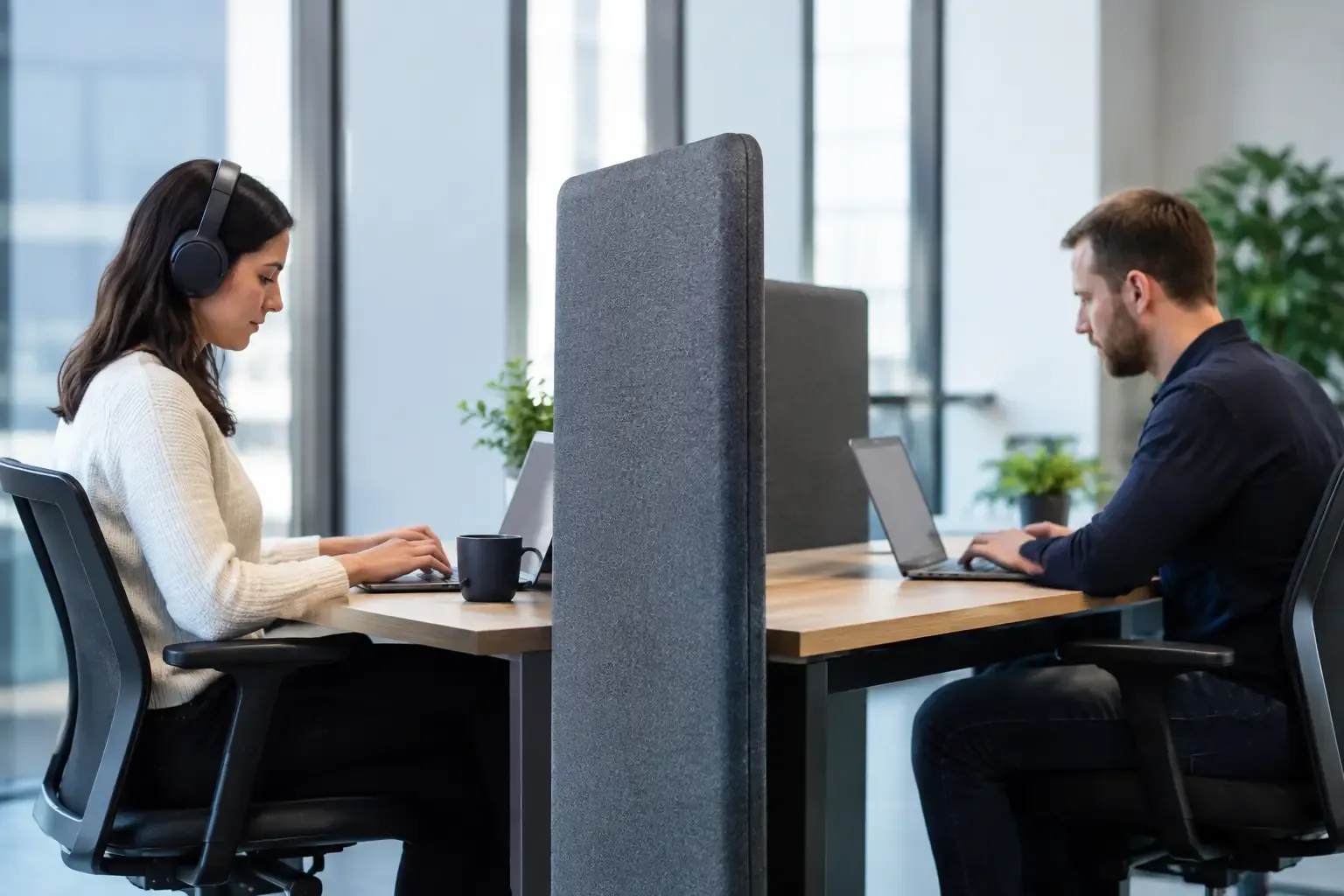
A freestanding screen between teams can also break the direct line of sound. It will not stop a colleague speaking loudly a few metres away, but it can reduce how clearly speech carries across adjacent desks. Desktop screens work in a similar way, creating a small degree of separation around individual workstations and helping to contain nearby conversations.
This distinction matters when planning a project. Sound absorption reduces echoes and background noise within a room. Sound insulation prevents sound travelling from one room to another. A fabric-covered office screen is typically useful for the first job and offers limited help with the second.
No. Acoustic screens do not block noise completely, particularly low-frequency sound such as bass, heavy footsteps, building services or vibration. They are also less effective where noise travels above, around or underneath them.
Think of a screen as one part of a practical acoustic strategy. If a call area is directly beside quiet desk work, screens can reduce the impact, but relocating the calls or creating an enclosed meeting room may be the better answer. Equally, if a space has hard floors, exposed ceilings and large glazed areas, adding screens alone may not overcome the amount of sound already reflecting around the room.
The trade-off is that screens offer flexibility at a far lower cost and with far less disruption than building partitions. They can be moved as teams grow, used to divide zones and incorporated into desk layouts without a full refurbishment. For many organisations, that makes them a sensible first step.
Acoustic screens tend to perform best when they are close to the source of the sound or close to the people affected by it. A screen positioned between neighbouring desks is generally more helpful than one placed at the far side of an open room.
They are particularly effective in open-plan offices where staff need visual separation as well as a reduction in conversational distraction. Bench desking can benefit from central dividing screens, while desktop return screens can give individual users more protection from activity behind or beside them.
Freestanding acoustic screens are useful for creating temporary zones. They can separate a collaboration area from focused workstations, form a small touchdown area or provide a backdrop around informal seating. In schools, they can help define reading corners, support areas and group-work spaces where flexibility is needed during the day.
Reception areas and shared public buildings can also benefit. Screens can soften the acoustics of a hard-surfaced waiting area while offering a modest level of visual privacy. However, where conversations include confidential personal, medical or financial information, a proper enclosed room or purpose-designed privacy solution will normally be required.
A low desktop screen may reduce visual distraction and absorb some nearby sound, but it cannot shield seated users from speech travelling over the top. Taller screens usually provide greater separation, especially between facing or adjacent workstations.
There is no single ideal height. A busy contact centre, for example, may need taller desk-mounted or freestanding products than a design studio where teams need easy communication. Screens should support the way people work rather than make the space feel closed in.
Gaps also affect performance. Sound naturally finds the easiest route, so a series of small screens with large open spaces between them will have a limited blocking effect. Where practical, use screens to create continuous runs around the areas that need them most.
The same screen can feel highly effective in one office and disappointing in another. Ceiling height, floor finish, window areas, desk density and the number of people on calls all influence the outcome.
A carpeted office with acoustic ceiling tiles may only need desk screens to deal with local conversations. A room with concrete floors, exposed soffits and minimal soft furnishings may need wall panels, ceiling baffles, upholstered seating or rugs as well. This is why a quick conversation about the room is often more useful than choosing a screen from a photograph alone.
Start with the problem you are trying to solve. Is the main issue echo across the room, lack of privacy between desks, noise from a collaboration zone, or a need to make a large space feel more organised? The answer will guide the product type, height and layout.
Desk-mounted screens are a practical choice for fixed workstations and bench desks. They are available in different widths and heights, with options for central, side or rear positioning. Check how the screen fixes to the desk, particularly if desks have a modesty panel, cable tray or sit-stand mechanism.
Freestanding screens suit flexible layouts and can be useful where furniture may move regularly. Look for stable feet, linkable options where longer runs are needed, and finishes that work with the wider scheme. In customer-facing spaces, the colour and fabric choice can make the screen feel like a considered part of the interior rather than an afterthought.
For larger or noisier spaces, combine screens with other acoustic products. Wall panels deal with reflected sound at the room perimeter, while ceiling baffles or suspended panels can help where high ceilings are causing sound to travel. A mix of measures is often more effective than relying heavily on one product category.
Acoustic products are sometimes sold with overly simple promises. A screen will not make an open-plan office soundproof. It will not stop noise coming through a wall, and it cannot replace a private room for sensitive discussions.
It is also worth avoiding the assumption that thicker always means better. Material performance, overall screen size, placement and the room itself are more relevant than thickness alone. A well-positioned, suitably sized absorbent screen can be more useful than a heavier product placed where sound simply travels around it.
Finally, do not overlook behaviour and zoning. Setting aside a place for longer calls, locating printers away from quiet desks and providing bookable meeting areas can reduce noise at source. Furniture and screens then have a clearer role in supporting the layout.
Before ordering, walk through the space at its busiest time. Notice where people raise their voices, where calls overlap and which desks receive the most complaints. This often reveals whether the problem is mainly local or affects the whole room.
A simple plan showing desks, circulation routes, windows, meeting areas and existing soft finishes will help identify sensible screen positions. It also prevents common problems such as blocking access to power, making desks feel cramped or fitting screens that interfere with monitor arms and height-adjustable desks.
For organisations planning a wider fit-out, acoustic screens are easiest to specify alongside desks, seating, storage and power provision. That allows the workspace to be planned as a whole, rather than trying to correct noise after every desk is in place. Orbis Furniture can help buyers consider screen options alongside the intended layout, budget and day-to-day use of the space.
The best acoustic screen is not necessarily the tallest or most expensive one. It is the one that addresses a clear source of distraction, fits the furniture properly and works with the way your people need to communicate. If the noise problem is more complex, get in touch before committing to a layout - a little planning can prevent an expensive compromise later.
Projects and fit-outs
Chairs, desks, tables, storage and soft seating, with free standard delivery to UK mainland addresses on orders over £500 excluding VAT.
Office and educational furniture specialists based in Lowestoft, supplying Suffolk, Norfolk and the whole of the UK. Chairs, desks, tables, storage and soft seating from one supplier, at low prices.
Get in touch
Riverside Business Centre, Riverside Road, Lowestoft, Suffolk, NR33 0TQ
Delivery
Free standard delivery to UK mainland addresses on select orders or orders over £500 excluding VAT. Next working day, pre-build and installation options available on most ranges at checkout.
© 2026 Orbis Furniture Ltd. Registered in England and Wales, company number 12397240. VAT number GB 362 8523 86.