Free UK mainland delivery over £500 ex VAT

Commercial Desk Storage Combinations That Work
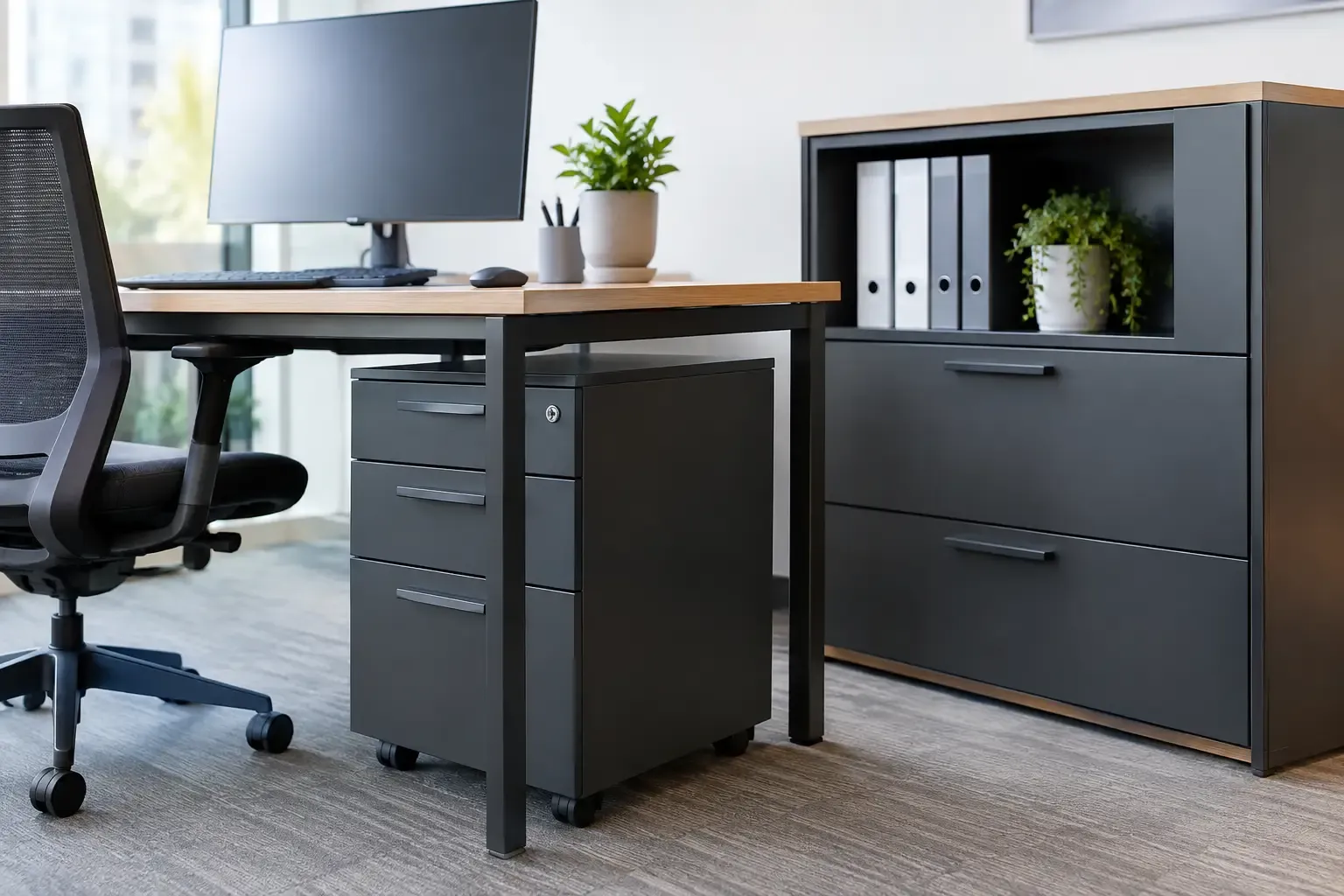
A workstation can look well furnished on move-in day and still become unworkable within weeks. Papers collect at the edge of desks, personal items move into walkways, and shared supplies end up wherever there is a spare surface. Well-planned commercial desk storage combinations prevent that drift by giving everyday work a proper home from the outset.
For offices, schools and public sector workplaces, the right answer is rarely just a desk with a pedestal. Storage needs to suit the work being done, the room available, the level of security required and the way people move around the space. A good combination keeps the workstation clear without making the room feel cramped or difficult to reconfigure later.
Start with what people need to store
Before choosing desks or cabinets, look at the items staff actually use during a normal week. A finance team may need secure filing close to hand. A customer service team may only need space for headsets, stationery and personal belongings. Teaching staff may require lockable storage for resources, while a hot-desking area benefits from individual lockers rather than assigned drawers.
This is where many fit-outs go wrong. Buying the same pedestal for every desk may look consistent and keep procurement simple, but it can waste money and floor space if half the drawers are never used. Equally, relying entirely on central cupboards can leave staff making repeated trips across the office for routine items.
It helps to divide storage into three practical zones: personal items, daily-use materials and archive or bulk supplies. Personal storage should be secure and convenient. Daily-use storage needs to be within easy reach. Archive materials can sit further away, provided they remain accessible and appropriately organised.
Choosing commercial desk storage combinations
The most effective commercial desk storage combinations balance individual workspace with shared capacity. They should support the tasks taking place at the desk without turning every workstation into a bank of cupboards.
A fixed pedestal is often a sensible choice for permanent, assigned desks. It gives the user a consistent place for stationery, files and small personal belongings, and can help define a workstation in open-plan layouts. Mobile pedestals offer more flexibility, particularly where teams may be rearranged or desks are used for different purposes over time. They can be moved beneath a desk, positioned beside it or relocated when a department changes shape.
Desk-high cupboards work well where there is more paperwork, equipment or reference material to manage. Positioned alongside a desk, they extend the usable worksurface and create a practical return without the cost or footprint of a full corner desk. This can suit administration teams, school offices and busy reception back-office areas.
For bench desking, shared low-level storage is often more efficient than fitting every position with individual drawer units. Central cupboards or pedestal banks can provide useful separation between desk runs while keeping the overall layout open. The trade-off is that shared storage needs clear ownership and regular housekeeping, otherwise it quickly becomes a dumping ground.
When under-desk storage is the right choice
Under-desk units are ideal where users need fast access to a modest amount of storage and the desk has enough leg room to accommodate them comfortably. They are particularly useful for administrative roles, individual offices and permanent staff workstations.
They are less suitable for compact bench desks, sit-stand desks or spaces with a high proportion of wheelchair users, where knee clearance and access need careful consideration. In these settings, personal lockers and nearby shared cabinets may be a better use of the floor area.
When desk-high storage makes more sense
Desk-high storage provides a more substantial solution for teams that handle paper files, samples, devices or specialist equipment. It can create a useful L-shaped work area when placed at right angles to a straight desk, or form a neat run of storage alongside a row of workstations.
Consider door opening space before specifying cupboards. Sliding-door cabinets can be useful in tighter offices because they do not project into aisles. Tambour units are another option where access is frequent and floor space is limited. For rooms with generous circulation, standard hinged-door cupboards can provide good value and a wide choice of sizes.
Protect circulation space and access
Storage should make an office easier to use, not create obstacles. Pedestals, cupboards and filing units all affect how people reach their desks, move through the room and leave safely in an emergency. A layout that looks efficient on a plan can feel crowded once chairs are pulled out and cupboard doors are open.
Allow enough room behind seated users and keep main walkways free from mobile units, bags and temporary boxes. In reception areas, meeting rooms and education settings, this matters even more because visitors and students may be unfamiliar with the space.
Think about maintenance as well. Power modules, cable trays, skirting and access to windows can be affected by a run of storage. A site survey helps identify these details before furniture arrives, rather than asking installers to solve them on the day.
Use shared storage for the whole team
Not everything belongs at a desk. Printers, paper stocks, presentation materials, cleaning supplies and archived files are usually better housed in shared storage areas. Centralising these items can reduce clutter at individual workstations and make stock levels easier to manage.
The key is location. A print station should be close enough to be convenient, but not so close that noise and footfall disturb concentrated work. A bank of tall cupboards can be useful at the edge of an open-plan area, where it provides storage and creates a subtle visual boundary between teams.
In smaller offices, a single storage wall may combine low cupboards, tall cabinets and open shelving. This gives frequently used items an accessible place while keeping less attractive supplies behind closed doors. Open shelving can look smart when it is actively maintained, but it demands discipline. If tidiness is unlikely to be consistent, closed storage is usually the safer choice.
Build in security where it is needed
Lockable storage is not only for confidential files. It can protect laptops, medicines, keys, staff belongings, controlled materials and valuable equipment. The level of security should reflect the contents and the environment, rather than applying the same lockable solution everywhere.
For shared offices and hot-desking areas, lockers are often more useful than desk pedestals. They provide each user with a secure place for belongings without tying storage to a particular workstation. In schools and public sector settings, lockable cupboards can also help keep records and resources appropriately controlled.
Remember that locking drawers do not automatically make a cabinet suitable for sensitive information. Where document retention and data handling requirements apply, check the organisation's internal policy before selecting storage. Fire resistance, key management and access control may all need consideration.
Keep the finish consistent, but not at the expense of function
Matching desk and storage finishes creates a professional, planned appearance, particularly in client-facing offices and reception areas. The same timber tone, desk frame colour and handle style can make a mixed range of furniture feel like one coordinated installation.
However, finish should come after suitability. A cupboard that matches perfectly but is too shallow for lever arch files, too tall for the room or awkward to access will soon become a frustration. It is often better to choose a practical storage format first, then select complementary finishes from a broad commercial range.
For schools and high-use offices, durable surfaces and easy-clean finishes are worth considering. Lighter colours can help compact rooms feel more open, while darker finishes may be more forgiving in busy areas. There is no single right choice, but consistency across shared spaces usually makes future additions easier to manage.
Plan storage alongside the desk layout
Desk storage works best when it is planned as part of the wider furniture scheme, not added after desk positions have been decided. A proposed layout should account for desk dimensions, chair movement, power access, filing needs, shared equipment and future growth.
This is especially useful when combining bench desks, sit-stand desks and conventional workstations in one office. Sit-stand desks need clear movement around the worktop and should not be restricted by adjacent cupboards. Bench desks may benefit from central shared storage, while manager offices may require more substantial desk-high units or filing cabinets.
For an organisation furnishing several rooms, standardising a small number of storage combinations can simplify ordering and replacement without forcing every area into the same format. For example, one combination may suit fixed administration desks, another may suit agile team areas, and lockers may support hot-desking or visitor-heavy locations.
Orbis Furniture can help assess these practical details through space planning support, product guidance and site surveys within East Anglia. For projects further afield, remote planning support can still help buyers compare suitable desk, cupboard, pedestal and locker options before placing an order.
The best storage scheme is the one staff barely notice because it makes everyday work easier. Start with how the space is used, allow room for people as well as furniture, and get in touch when you need a practical recommendation that fits both the room and the budget.