Free UK mainland delivery over £500 ex VAT

A waiting room chair has a tougher job than it first appears. It needs to make visitors feel welcome, cope with constant use, suit the look of the building and remain easy for staff to keep clean. The best visitor chairs for waiting rooms balance all of those needs without making the reception budget work harder than it needs to.
For offices, schools, healthcare settings and public sector buildings, the right choice starts with how the space is actually used. A quiet consultancy reception has very different demands from a busy school office or a customer-facing service desk. Getting the basics right before choosing colours, fabrics and finishes will save time and prevent costly replacements later.
Comfort matters, but it is not the only measure of a good visitor chair. People may be seated for five minutes or an hour, and they arrive with different ages, mobility needs and expectations. A supportive back, a sensible seat height and enough room between chairs will usually do more for the visitor experience than an oversized, deeply cushioned chair that takes up too much floor space.
Durability is equally important. Reception furniture is often used by people who do not work in the building and are unlikely to treat it as carefully as office staff. Look for commercial-grade frames, hard-wearing upholstery and finishes that can handle bags, coats, wet weather and frequent cleaning. A domestic-style chair may look attractive at first, but it can quickly show wear in a high-traffic entrance area.
The best specification also depends on who uses the waiting room. In a school, wipe-clean surfaces and easy movement may be priorities. In a professional services office, upholstery, armrests and a more refined appearance may be appropriate. In a healthcare or public-facing environment, hygiene, stability and accessibility should lead the decision.
It is tempting to choose seating from a brochure and then work out where it will go. In practice, a simple layout plan should come first. Measure the available footprint, allowing for doors, reception counters, walkways, radiators and fire exits. Visitors should be able to enter, sit down and leave without squeezing past other people or obstructing access.
As a general rule, waiting areas need clear circulation as well as seating capacity. Trying to fit one extra chair into a compact reception can make the whole area feel crowded and less welcoming. It can also create practical problems for wheelchair users, pushchairs and anyone carrying equipment or luggage.
Think about the direction chairs face, too. Rows against a wall are efficient, but can feel formal and impersonal. Small groups of two or three chairs may suit a larger reception, especially where visitors are likely to arrive together. Modular seating can help create defined zones, although individual chairs are usually easier to rearrange when your needs change.
A good waiting room should offer a choice of seating rather than one fixed format. Chairs with arms can be easier for older visitors and people with limited mobility to get in and out of. A slightly higher seat can also be more comfortable for many users.
Avoid relying entirely on low lounge seating, particularly in public-facing buildings. It may look relaxed, but it is not always practical for everyone. Keeping at least one clear space beside the seating area for a wheelchair user is a sensible part of the layout, not an afterthought.
There is no single chair that suits every waiting room. Most successful schemes combine the right chair type with the level of traffic, expected dwell time and cleaning requirements.
Four-leg chairs are a dependable choice for receptions, school offices, meeting room overspill and general visitor seating. They are stable, familiar and available in a wide range of shell, fabric and frame options. They tend to suit spaces where visitors wait for short to moderate periods and where the seating layout is unlikely to change every day.
A polypropylene shell is practical for busy, wipe-clean environments. Upholstered seat pads or fully upholstered versions offer greater comfort and a softer appearance. The trade-off is that fabric needs more care, so consider stain-resistant upholstery where food, drinks or muddy shoes are likely.
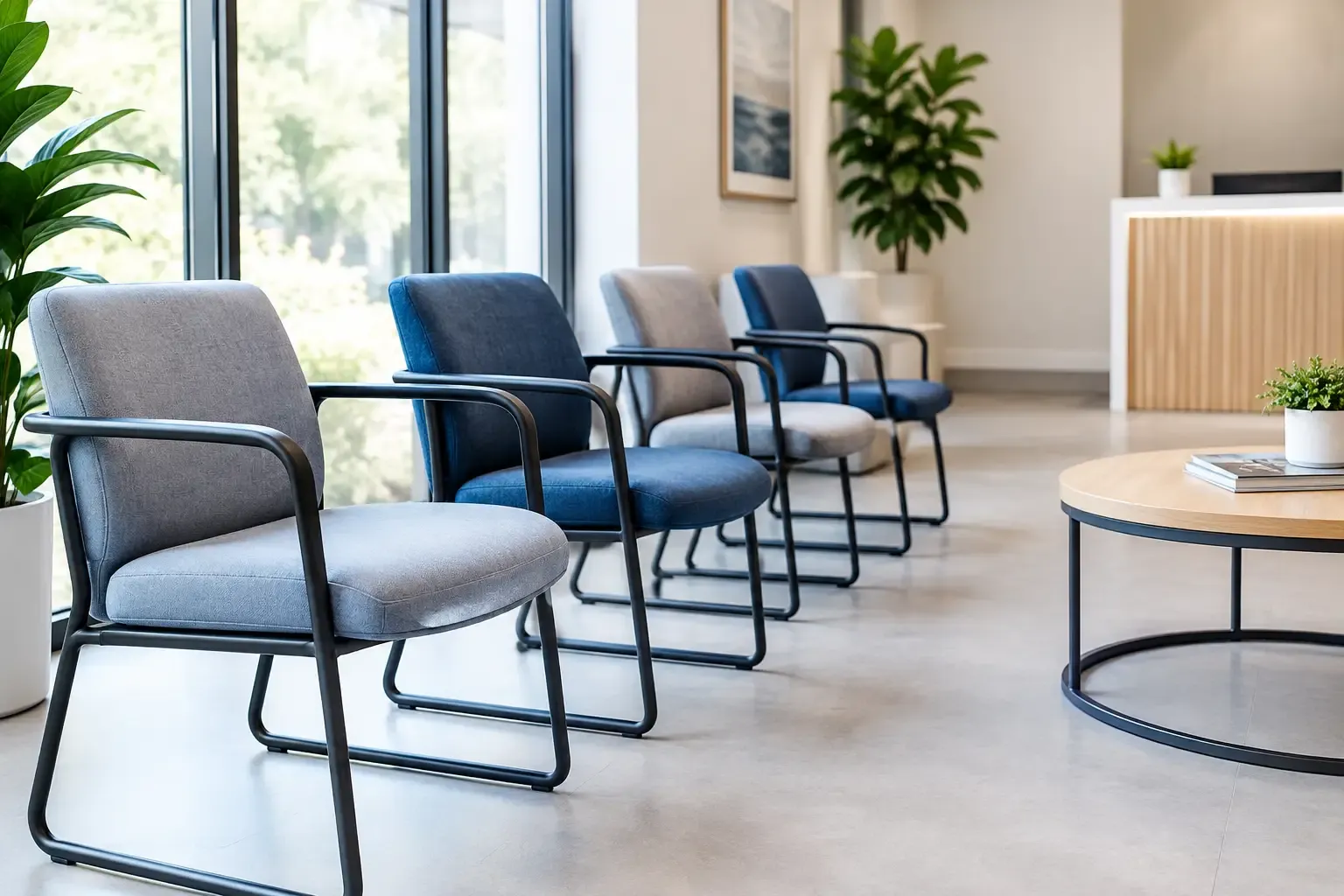
Cantilever chairs have a frame that flexes slightly as the user sits down. This can make them feel more forgiving than a standard four-leg chair, while retaining a smart, professional look. They are often used in offices, consultation rooms and client reception areas.
They work particularly well where visitors may wait a little longer, but check the frame quality and weight rating. A lower-priced cantilever chair can be perfectly suitable for occasional use, while a busy service reception will benefit from a stronger commercial specification.
Stackable visitor chairs are useful when a waiting area doubles as a meeting, training or event space. They allow teams to bring out additional seating when needed, then clear the area again quickly. Schools and public sector sites often benefit from this flexibility.
Stackability does involve compromise. Chairs designed to stack high can be lighter and less generously padded than fixed visitor seating. If they will be used every day, choose a model that remains comfortable and stable in normal use, not just convenient in storage.
Beam seating provides several linked seats on a shared frame. It is a strong option for high-footfall receptions, clinics, transport-style waiting areas and busy public buildings. It keeps layouts orderly, simplifies cleaning beneath the seats and avoids chairs drifting around the room.
The limitation is flexibility. Once installed, beam seating is less easy to move or adapt, so it needs careful planning. It is best where visitor numbers are consistent and the room has a clear, permanent purpose.
Soft seating can make a reception feel less formal and more welcoming, particularly in design-led offices, hospitality spaces and client-facing workplaces. Sofas, tub chairs and modular pieces are useful for longer waits or informal conversations.
Use them with care in compact rooms. Large soft seating can absorb valuable floor space, and very low furniture may not suit every visitor. A practical approach is to combine one or two comfortable lounge pieces with supportive standard chairs, rather than filling the entire area with soft seating.
Material choice has a direct effect on cleaning, lifespan and the overall feel of the space. Plastic shells are cost-effective, durable and easy to wipe down. They are a sensible option for schools, staff entrances, busy receptions and areas exposed to wet coats or outdoor footwear.
Fabric upholstery adds warmth and can help absorb sound in a lively reception. It works well in offices where visitors may wait for appointments, but it should be selected with maintenance in mind. Darker tones, patterned fabrics and commercial stain-resistant finishes are often more forgiving than pale, delicate materials.
Vinyl or faux leather can offer a neat appearance and straightforward cleaning, especially where hygiene is a priority. Quality varies considerably, however. Cheaper finishes may crack or peel over time, particularly on heavily used chair edges. Ask about the intended use and cleaning guidance before making a decision.
Metal frames are usually the most durable choice for commercial visitor seating. Chrome can look smart but may show fingerprints, while black, silver or powder-coated frames are often easier to live with. Timber details can soften the look of a reception, though they may be better suited to lower-traffic spaces.
Waiting room seating contributes to the first impression visitors form of your organisation. That does not mean every chair needs to match a corporate colour exactly. In fact, a full room of bright branded furniture can become tiring or date quickly.
Neutral base colours such as charcoal, grey, navy and black are practical and versatile. Accent chairs can then introduce a school colour, departmental identity or a more welcoming touch near reception. In healthcare and public settings, consider how colours will look under strong lighting and how easily marks will show.
Style should support the building rather than compete with it. A clean, simple chair design often gives the greatest longevity, especially when reception furniture is expected to stay in place for several years. If you are fitting out several areas, choosing a coordinated family of visitor, meeting and breakout chairs can give the building a more organised appearance.
The lowest purchase price is not always the best value. A chair used dozens of times each day needs to withstand far more than a chair in an occasional meeting room. Replacement costs, disruption and inconsistent furniture across the building can soon outweigh a small upfront saving.
That said, spending more is not automatically the answer. A straightforward stackable chair may be exactly right for a school reception with flexible requirements, while upholstered cantilever chairs may be worth the extra cost for a legal practice or customer service office. The key is to match the product to the use rather than paying for features that will not benefit the space.
When comparing options, look beyond the image and headline price. Check dimensions, frame construction, upholstery suitability, stacking capability, glides for your floor type and expected lead times. If installation is required, factor this into the project from the start, particularly where access is restricted or a reception needs to remain operational.
Choosing visitor chairs is easier when someone looks at the room as a whole. The reception desk, storage, signage, power access, acoustic treatment and circulation routes all affect whether the seating arrangement works well in daily use.
Orbis Furniture can help organisations assess suitable visitor seating alongside the wider reception or waiting area, with practical guidance on layouts, product choices and value-led options. For projects in East Anglia, a site survey can be especially useful where measurements, access or installation need careful consideration.
A well-chosen waiting room chair does not need to be complicated. It simply needs to suit the people using it, the pace of the building and the budget available. Start with the space and the daily reality of the area, then get in touch for help narrowing down chairs that will continue to look smart and perform well long after the initial fit-out.
Projects and fit-outs
Chairs, desks, tables, storage and soft seating, with free standard delivery to UK mainland addresses on orders over £500 excluding VAT.
Office and educational furniture specialists based in Lowestoft, supplying Suffolk, Norfolk and the whole of the UK. Chairs, desks, tables, storage and soft seating from one supplier, at low prices.
Get in touch
Riverside Business Centre, Riverside Road, Lowestoft, Suffolk, NR33 0TQ
Delivery
Free standard delivery to UK mainland addresses on select orders or orders over £500 excluding VAT. Next working day, pre-build and installation options available on most ranges at checkout.
© 2026 Orbis Furniture Ltd. Registered in England and Wales, company number 12397240. VAT number GB 362 8523 86.